
Centre County Release Date Limits
The public Pennsylvania Department of Corrections locator has two modes. Its Inmate Locator covers people now under PADOC jurisdiction. The Department Supervised Individual Locator covers people now supervised by PADOC in the community. The public inmate detail reviewed for this project did not show a projected, tentative, minimum, maximum, or release-date field. That missing field matters. It means a user cannot obtain a current state prisoner’s projected release date merely by opening a public result.
The locator still helps identify the correct person and custody track. Its search supports a name, inmate or parole number, gender, committing county, location, citizenship, date of birth, or approximate age. A detail can show the institution, DOC and Parole Board numbers, aliases, committing county, photograph date, and update time. A supervised result has a “Release Date” label and district-office details, but that date is not a projected-date field for someone still in prison. It also does not prove when a person left Centre County Correctional Facility.
Find a Centre County Release Date
First decide whether the person is held before trial, serving a county sentence, or confined in a state prison. Centre County Correctional Facility holds both pretrial detainees and people serving county terms. SCI Benner Township is an active state prison. SCI Rockview is closed, and its former population was transferred rather than released as a group. A statewide PADOC search is therefore essential for a name once tied to either state institution.
- Identify the custody authority. Match the full name, date of birth or age, agency number, committing county, and facility. A name alone is not enough.
- Check both PADOC modes for a state case. Search the Inmate Locator, then the Department Supervised Individual Locator. A move to the supervised side can support a parole transition, but it does not prove full discharge.
- Use county records for a CCCF case. Call Centre County Correctional Facility at 814-355-6794. Option 1 reaches Inmate Records, while Option 0 is listed for a present-custody inquiry.
- Read the court docket. Search the UJS portal for bail, sentencing, amended orders, disposition, and parole-related entries. The docket supplies legal context, while the jail supplies the time custody actually ended.
- Request the existing record. If the date remains unclear, use the county NextRequest portal or PADOC records. Ask for a release or discharge date and manner tied to the booking or DOC number.
For the broader named-person trail, the Centre County released-inmate search and records coverage distinguishes county, state, federal, and immigration sources. No result should be phrased as proof of release. Full discharge, a spelling error, data delay, and a transfer can each cause a name to vanish.
Note: Keep the search date and the identifiers used because custody and supervision systems change as agencies process new events.
Pennsylvania Minimum and Maximum Dates
Pennsylvania uses minimum and maximum terms for many state sentences. The minimum generally marks the point when ordinary parole can be considered. It is not a promise of release. The maximum is the outer sentence boundary before other lawful changes are considered. For a simple illustration only, a two-to-four-year sentence ordinarily puts parole eligibility at the two-year point and the maximum at four years. Aggregation, sentence amendments, time calculations, recommitment, detainers, and other rules can change an individual timeline.
Under 61 Pa.C.S. § 6137, the Pennsylvania Parole Board generally may not parole a person before the court-fixed minimum, subject to statutory exceptions and commutation. Life and death sentences fall outside ordinary Board parole power. Even after the minimum arrives, the Board may deny parole or require further review. Release conditions and processing can follow a grant.
The state’s official parole process explanation expressly says Pennsylvania does not use a rule that every inmate must serve 85 percent before parole. A fixed 85-percent estimate is therefore the wrong method for a Centre County release date lookup. The sentence and applicable Pennsylvania paths control.
The Pennsylvania Parole Board’s minimum-date explanation is shown in the captured official source below.
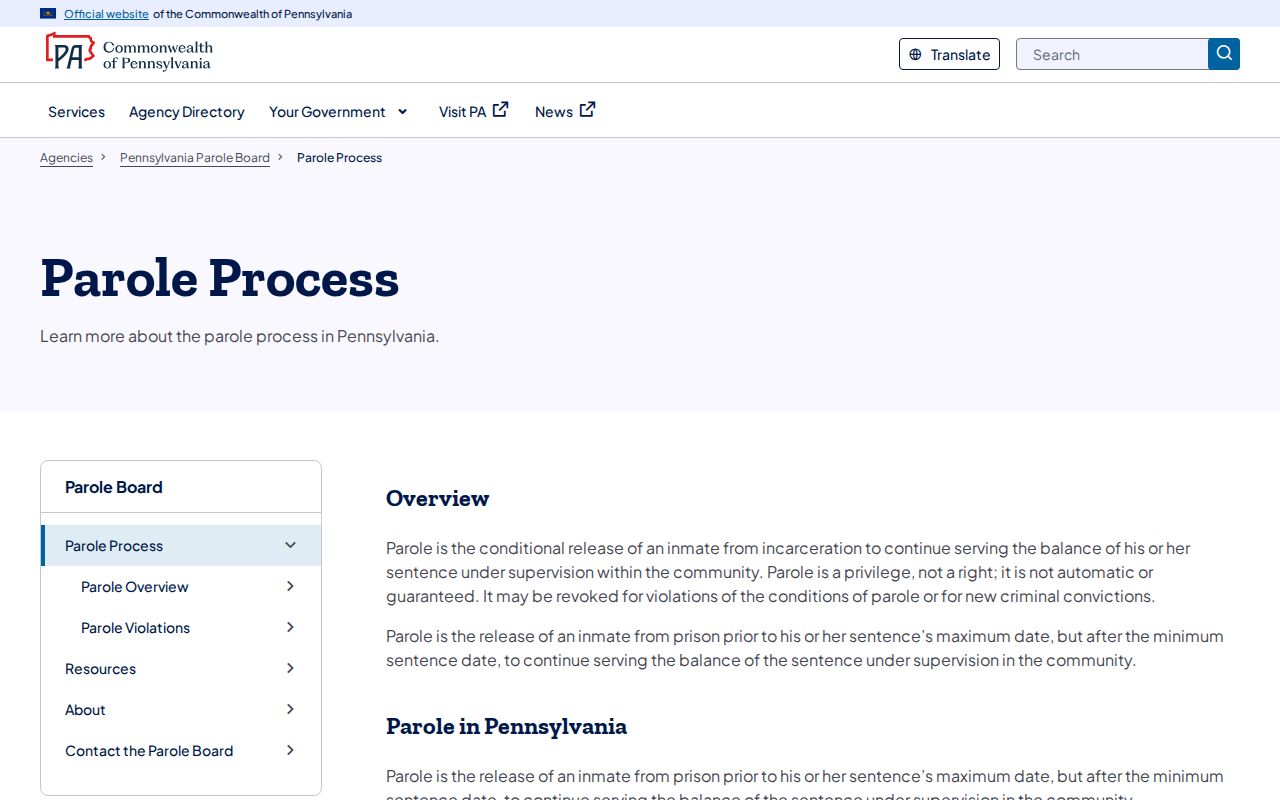
The source distinguishes eligibility at a minimum date from a guaranteed physical release, which is the key reading rule for any projected date.
Centre County RRRI Release Dates
The Recidivism Risk Reduction Incentive can create an earlier statutory minimum for an eligible state sentence. RRRI is not general good time. The sentencing court must set an RRRI minimum, and PADOC must later certify continued eligibility and completion of the required program plan. The official example uses an 18-month RRRI minimum for a typical two-to-four-year sentence, but an example cannot calculate a real person’s date.
61 Pa.C.S. § 4505 is the key RRRI minimum provision. The PADOC RRRI explanation describes how the incentive fits the sentence and certification process. Eligibility can be lost or certification may not occur. A detainer or pending Board processing can also prevent community release on the RRRI date.
Short Sentence Parole under 61 Pa.C.S. § 6137.1 is another distinct path and may proceed without an ordinary interview for eligible cases. Commutation can also alter a minimum, but clemency is handled through the Board of Pardons and Governor, not the standard parole calendar. Neither path supports a generic calculator.
CCCF Early Release Has No Formula
Centre County’s most distinctive date rule concerns the voluntary Early Release Program at Centre County Correctional Facility. The CCCF inmate handbook says the program can permit release before a county minimum. Requirements are posted within residential units, and an incarcerated person applies through a counselor. Admission is not a right. The court may deny or exclude participation, and serious misconduct may cost earned time.
The public handbook does not state a universal number of days earned for a set number served. No responsible Centre County release date estimate can turn this program into a one-size-fits-all equation. The right path is to ask the counselor about the person’s program status, review the sentencing docket, and obtain the facility’s existing release record once custody ends.
- Minimum date
- The first eligibility point set by the sentence or an applicable statutory path, not a guaranteed departure day.
- Maximum date
- The sentence boundary after which confinement on that term ordinarily ends, subject to lawful changes and other holds.
- Detainer
- A hold from another authority that can cause an immediate transfer when the current sentence or custody ends.
- Discharge
- The end of the identified correctional or supervision authority, which differs from parole into continued supervision.
Note: Work release and an approved furlough allow limited absence with a duty to return, so neither event proves discharge.
Centre County Custody Date Differences
A pretrial detainee at CCCF has no sentence-based projected release date. Bail may authorize release, but the court’s entry is not the same as the facility’s execution time. Another charge or detainer can keep the person in custody after bail is met. A dismissal or release order can also end one legal basis while a different authority still has a hold. For that reason, the UJS docket and CCCF status must be read together.
A person serving a county sentence follows a different track. A minimum can relate to county parole or an approved early-release path, while the maximum marks sentence completion for that term. County parole means conditional community supervision before the maximum. Probation is a community sentence or supervision component and is not a projected release formula. A county-sentenced person can move into local supervision without ever appearing in PADOC’s supervised-person database.
State custody begins another timeline. Transfer from CCCF to PADOC ends the county jail stay but does not place the person in the community. A PADOC prisoner may later leave an SCI on state parole, enter a prerelease setting, discharge at the end of the state term, or pass to another authority. Each event needs its own label and date. Matching the authority first prevents a county custody-end date from being mistaken for the final state release date.
Why Centre County Release Dates Change
A projected date reflects the facts known when it was calculated. Later orders, institutional decisions, sentence rules, and new custody claims can alter what happens. The table separates changes to the date itself from events that leave the date intact but change the destination.
| Factor | Effect on the release timeline |
|---|---|
| Parole decision | The Board may grant, deny, defer, rescind, or later recommit. Minimum-date eligibility alone does not control the outcome. |
| RRRI certification | An eligible statutory minimum depends on the court’s sentence and PADOC certification. Failure to qualify removes that earlier path. |
| Earned-time loss | Serious misconduct at CCCF may cost earned time and affect an internal early-release track. |
| Court order | A sentence amendment, time-served ruling, bail decision, dismissal, or other order can change legal authority for custody. |
| Detainer or hold | The term may end as calculated, but another county, PADOC, ICE, USMS, or other authority may take custody. |
| Transfer | A new institution or agency can appear without any release into the community. Benner’s transport role makes this caution especially important. |
A Board grant date, court-order timestamp, and physical release time can all differ. Facility processing may follow the legal decision. At CCCF, the public FAQ says processing time varies when many bookings and releases occur, while no fixed release hour is published. This is another reason to confirm a pickup only with the facility.
Confirm a Centre County Release
PA SAVIN through VINELink can send notice of a county-jail or state-prison release, escape, or movement. Registering for an alert can help with a pending event, but a movement notice is not a community release. The dedicated VINE Inmate Check explains the Pennsylvania search, notification methods, and PIN acknowledgment.
For a CCCF date, call Inmate Records and ask whether custody ended, on what date, and whether the recorded result was community release or transfer. If documentary proof is needed, submit a narrow request through the Centre County records portal. Name the person, approximate booking span, and booking number if known. Ask for the existing custody-end date and time, release or disposition code, and receiving authority if recorded.
For a state prisoner, use the public locator for current identity and location, then seek a case-specific date from PADOC or the Parole Board record. A fully discharged person may appear in neither public locator mode. PADOC historical records are therefore the proper fallback. Always distinguish release from PADOC custody, release to state supervision, transfer between prisons, and full discharge.