
Centre County Parole vs Probation
Parole and probation can both require a person to report in the community, but they arise in different ways. Parole is conditional release from a custodial sentence before the maximum date. Probation is a community sentence or a supervision term imposed by a court. It does not always follow a jail stay. For a county sentence, Centre County Probation and Parole may supervise either county parole or probation. State parole after a Pennsylvania state-prison sentence is supervised through the Pennsylvania Department of Corrections.
The sentence and court record set the boundary. The word “parole” alone does not prove that the Pennsylvania Parole Board has the case. Someone released from Centre County Correctional Facility after a county sentence may report to the local office and never appear in the state Department Supervised Individual Locator. Conversely, a person paroled from SCI Benner Township can appear in that state locator even after the inmate result has ended.
For state cases, 61 Pa.C.S. § 6137 generally bars ordinary Board parole before the court-fixed minimum, subject to statutory exceptions or commutation. The minimum creates eligibility, not a promised release. Pennsylvania also rejects the claim that a person must serve 85 percent of the maximum before parole. Eligibility, a Board grant, physical release, community supervision, and final discharge are separate points in the record.
| Point | Parole | Probation |
|---|---|---|
| What it is | Conditional community supervision during a custodial sentence | A court-ordered community sentence or supervision component |
| Centre County route | Local office for county parole; PADOC locator for state parole | Centre County Probation and Parole for local cases |
| Best record | Supervision record plus sentencing docket | Court docket plus local office confirmation |
| What it does not prove | The exact physical release time | That a person first served time in jail |
- Parole
- Conditional release to supervision before a sentence maximum.
- Probation
- A court-ordered term served in the community under stated rules.
- Discharge
- The formal end of the agency’s supervision over that sentence.
- Absconder
- A supervised person alleged to have stopped reporting or left supervision without approval.
Check Centre County Post-Release Supervision
Start with the authority that imposed the sentence. A Centre County Court of Common Pleas docket can show probation or a county sentence, and the Clerk of Courts maintains those criminal records. State records use an inmate number or Parole Board number and may point to a district office. Matching the person matters because a name alone can lead to the wrong case. Use a date of birth or approximate age, agency number, committing county, aliases, and the listed location when those fields are available.
- Review the public court docket to learn whether the sentence was county probation, county parole, or state imprisonment.
- For a county case, contact Centre County Probation and Parole and provide enough identity and case detail for the office to route the question.
- For state parole, open the PADOC locator and choose Department Supervised Individual Locator rather than Inmate Locator.
- Search by parole number when known. Otherwise use first and last name, then narrow with date of birth, age, or committing county.
- Open the likely record. Compare agency numbers, aliases, age, committing county, and district-office information before treating it as a match.
- If neither state mode returns a former state prisoner, use PA SAVIN and request an official discharge record from PADOC. Full discharge can remove a person from both current-population searches.
For a named person whose Centre County jail record is unclear, the full Centre County released-inmate search path adds the court docket and facility release record. Those sources help separate community release from a transfer to another authority.
Centre County Supervision Office
Centre County Probation and Parole is part of the Court of Common Pleas. It handles adult and juvenile probation plus county parole. This office is the local source when a CCCF release leads to county supervision. It is not a substitute for PADOC when a state parole sentence controls. A call is most useful when the caller has the full name, date of birth, court docket number, or county case details.
Centre County Probation and Parole
102 S. Allegheny Street, fourth floor
Bellefonte, PA 16823
814-355-6771
Monday through Friday, 8 a.m. to 4 p.m.
For state supervision, the PADOC supervised-person record may display the district office tied to the case. That is the right lead for reporting-location questions. If the question concerns whether the Parole Board granted parole or issued a decision, use the Board’s official decision inquiry channel. No public name-searchable decision database was identified in the research.
The official county office page shows the local program structure and the role of its prison liaison. The image below preserves that source context rather than substituting a general state page.
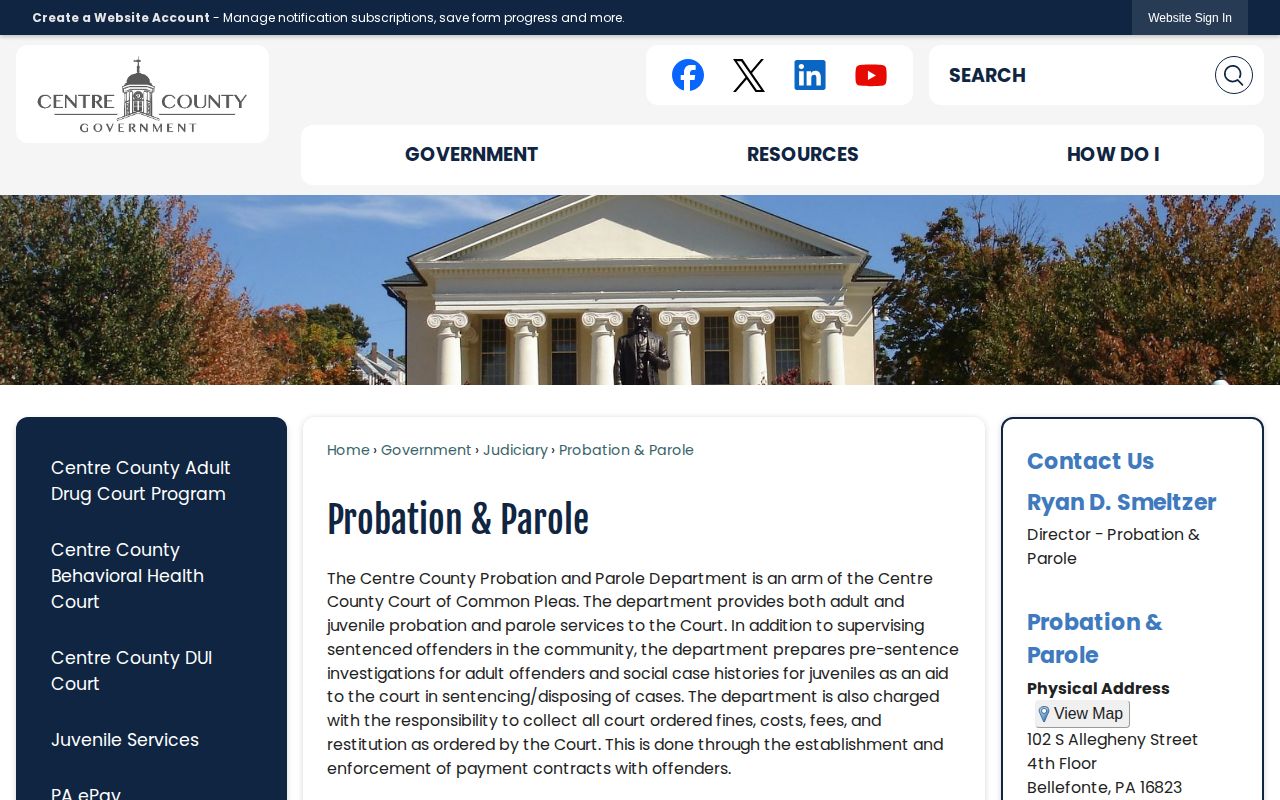
Its local role is distinct from the statewide parole locator and Board process.
Centre County Supervision Conditions
Supervision conditions come from the court, Parole Board, and supervising agency. They can include reporting, approved residence, travel limits, program participation, or other case-specific duties. The public locator does not replace the written order. Nor does a listed district office reveal every condition. The person under supervision and the assigned office should rely on the actual supervision documents.
A suspected violation does not automatically establish a new conviction. Pennsylvania publishes separate procedures for preliminary and revocation hearings. A preliminary parole-violation hearing addresses whether the person should remain held pending further action. A revocation hearing can follow a new conviction and may lead to recommitment. These are post-release processes, not the ordinary hearing used to decide initial parole eligibility.
PA SAVIN can send some state parole custody-status notices, but an alert must be read by event type. Release, escape, movement, and recapture mean different things. A transfer notice means the person changed locations or authorities. It is not community release. An exact violation or warrant question belongs with the supervising office, the relevant docket, or law enforcement.
Note: Public supervision data can change after agency action, so preserve the search date and confirm consequential details with the responsible office.
Centre County Parole Absconder Check
Pennsylvania’s Most Wanted parole-absconder list is a supplemental source. Entries can carry a photograph, county label, and tip channels. A Centre County label can help narrow a displayed entry, but the publication is selected rather than a complete warrant database. Absence from it does not clear a warrant or prove that supervision ended.
Use the list only to interpret an official displayed entry. Do not approach or try to detain a listed person. Tips can be directed to 800-932-4857 or RA-CRabscondertips@pa.gov. For a definitive question about active supervision or a warrant, contact the supervising office and the proper law-enforcement channel.
The official state screen also includes its own caution and county information. That context matters when reading a Centre County result.
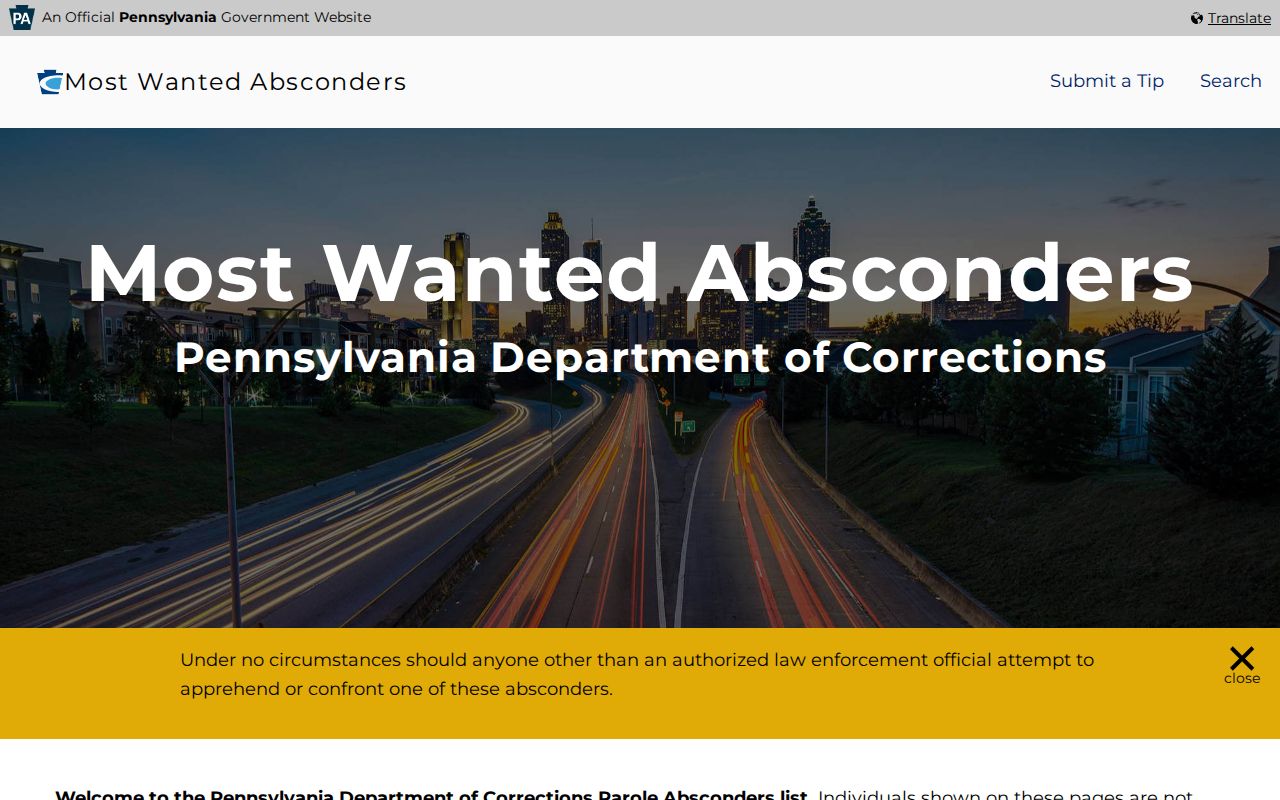
A publication match is meaningful, while a blank search remains inconclusive.
Centre County Reentry Support
The Centre County Reentry Coalition connects local criminal-justice and community participants. It meets every other month at Centre County Correctional Facility. The county uses a specific local measure of recidivism for its work: reincarceration within three years after release for a county-sentenced person. That definition should not be treated as a current supervision status for any one person.
State reentry takes a different route. SCI Benner Township has a Reentry Service Office for people within 18 months of a minimum or release point. Its work can start before physical release and should not be mistaken for proof that parole has been granted. Once a person enters state community supervision, the PADOC supervised locator and assigned district office are the better status sources.
The local and state systems can touch the same family without holding the same record. Centre County’s coalition can help people navigate local reentry resources, the county probation office handles county supervision, and PADOC handles state parole. Keeping those roles separate prevents a county-office call from being treated as a failed state search.
Note: Reentry program participation and parole eligibility can begin before release, so neither fact alone confirms that confinement has ended.
Centre County Supervision Discharge
Supervision ends through a formal discharge, expiration, court action, or other agency decision that applies to the sentence. Merely reaching a projected date does not close the case. The most reliable proof is the record from the office that supervised the person, read with the sentencing docket when the terms or authority are in doubt.
For county probation or county parole, ask Centre County Probation and Parole for the correct record channel and review the Common Pleas docket. For state parole, check both PADOC locator modes. A person who leaves the inmate locator and appears in the Department Supervised Individual Locator has likely moved from confinement to community supervision under PADOC. A person who later disappears from both may be fully discharged, but absence alone cannot prove it. Names, aliases, and identifiers should be checked before an official PADOC records request.
Release from confinement and discharge from supervision are separate milestones. A release record shows the end of custody under the named authority. A supervision discharge record shows the end of reporting and agency control for that sentence. Another case, detainer, or authority can still alter the person’s status, so each claim should stay limited to the record that proves it.
Pennsylvania’s Right-to-Know Law can provide an agency-record route when a former state prisoner no longer appears online, but exemptions may apply. Ask PADOC for the existing release or discharge date and recorded manner tied to the DOC number. County supervision records remain with the local court and office, so a state request should not be used as a substitute for Centre County’s own case and supervision records.